

RFID cards are now widely used in modern access control systems, hotel lock solutions, employee identification programs, public transportation systems, and smart security infrastructure. Yet despite their growing adoption, many businesses deploying these systems still do not fully understand how RFID cards work or what happens technically when a card communicates with a reader.
For procurement teams, system integrators, and product manufacturers, understanding RFID technology is not simply a technical exercise. Card frequency, chip compatibility, security architecture, and manufacturing quality all directly affect system performance and long-term reliability.
Whether you are sourcing custom RFID cards, integrating an access control card system, or developing smart lock products, understanding how RFID communication works helps avoid expensive compatibility issues later in the project lifecycle.
What Are RFID Cards?
RFID cards are contactless smart cards powered by two essential components: an integrated circuit (the RFID chip) and an embedded antenna. Together, these internal elements enable seamless wireless communication, allowing the card to exchange data with an RFID reader via radio-frequency technology.
Unlike legacy magnetic stripe cards that require direct physical swiping, this wireless capability allows users to simply tap or wave the card near a reader. By eliminating the need for physical contact, RFID technology delivers a faster, more efficient, and friction-free authentication experience.
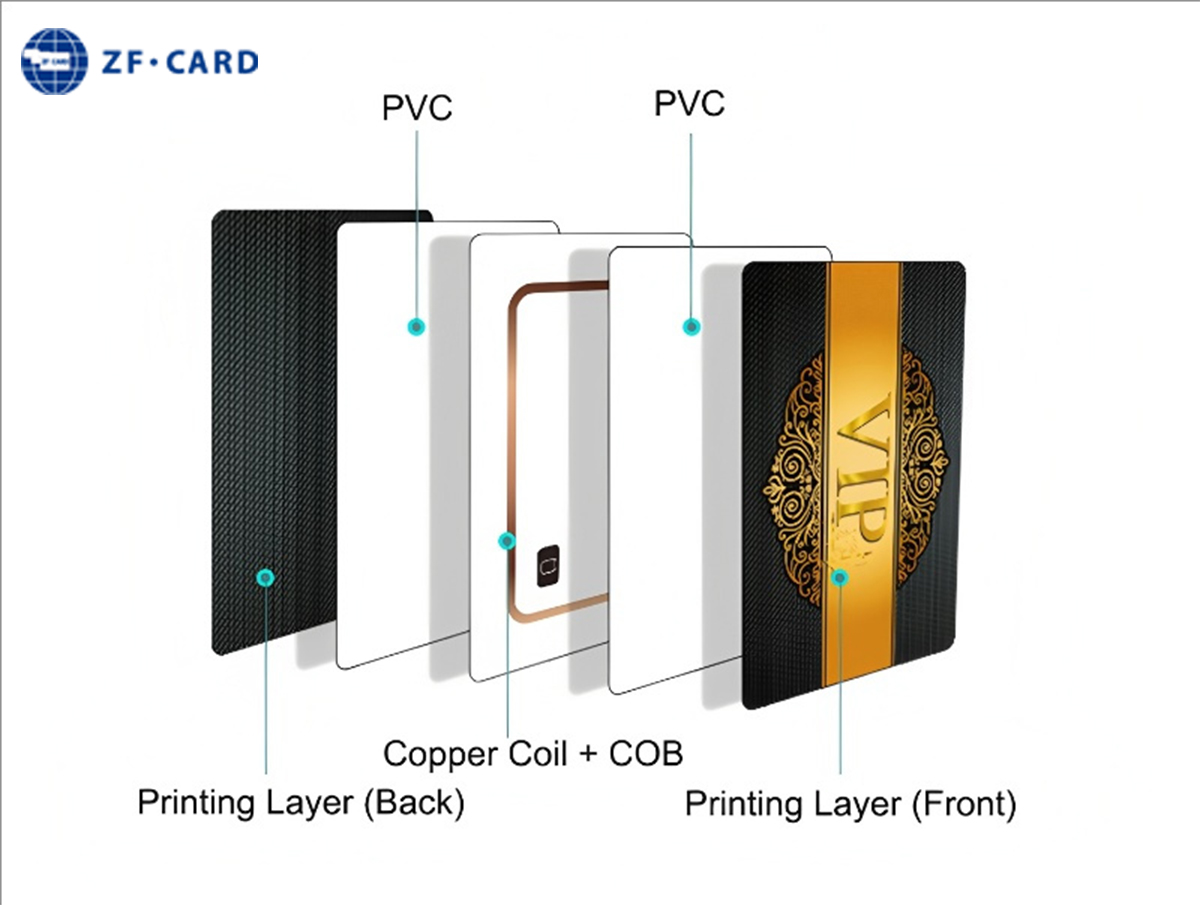
Why Contactless Identification Is Replacing Traditional Cards
Traditional card technologies gradually wear down because repeated physical contact damages magnetic strips over time. RFID-based contactless cards solve this issue by enabling frictionless authentication, reducing maintenance requirements while improving user convenience.
This is one reason hotels, office buildings, transportation providers, and enterprise security systems increasingly replace older card technologies with RFID solutions.
Industries That Depend on RFID Technology Today
RFID technology has become standard across many industries, such as:
- Hotels use RFID-enabled hotel key cards for guest room access.
- Office buildings deploy RFID employee badges for access management and visitor authentication.
- Manufacturers use RFID identification systems to track workforce attendance.
- Membership businesses issue programmable RFID cards for customer verification and loyalty systems.
- Transportation networks rely on RFID smart cards for automated fare collection.
How Do RFID Cards Work?
At the most basic level, RFID cards work by wirelessly exchanging information with an RFID reader via electromagnetic energy. The process typically happens in six steps.
Step 1 — RFID Reader Sends Radio Frequency Signal
The RFID reader continuously generates radio waves through its antenna, creating an electromagnetic field around the device.
Step 2 — RFID Card Antenna Receives Electromagnetic Energy
When the RFID card enters the reader’s field, the antenna embedded in the card captures some of the transmitted energy.
Step 3 — RFID Chip Activates Without Battery
Most RFID cards are passive devices, meaning they do not contain internal batteries.
Instead, the electromagnetic energy generated by the reader temporarily powers the RFID chip.
Step 4 — Card Sends Stored Data Back to Reader
Once activated, the chip transmits stored information such as identification credentials or encrypted access data.
Step 5 — System Authenticates Card Information
The RFID reader forwards the received data to the backend software, which verifies whether the card is authorized.
Step 6 — Access or Action Is Granted
If the authentication succeeds, the system performs a programmed action such as unlocking a door, recording attendance, or authorizing entry.
This entire communication process usually takes less than a second.
Science Behind How RFID Cards Communicate Wirelessly
While the user experience feels simple, the technology behind RFID communication involves multiple layers of engineering.
Electromagnetic Induction Explained
RFID communication begins through electromagnetic induction. The RFID reader generates an alternating electromagnetic field that induces an electric current in the card's antenna coil. This temporary electrical current powers the internal circuitry.
Energy Harvesting from RFID Readers
Passive RFID cards depend entirely on external energy sources. Instead of carrying an internal power source, the card temporarily harvests energy generated by the RFID reader. This design significantly extends product lifespan because there are no batteries that degrade over time.
Load Modulation and Signal Transmission
After activation, the RFID chip changes the electrical load placed on its antenna. These electrical changes alter the reflected signal, allowing the RFID reader to detect data being transmitted back from the card.
Reader-to-Card Authentication Process
Modern RFID systems often require authentication protocols before data exchange happens. This ensures that unauthorized cards cannot simply transmit data and gain access to the system.
Data Exchange Protocols
Most commercial RFID systems operate using internationally recognized standards such as ISO 14443, ISO 15693, and ISO 18000. These communication protocols ensure compatibility between RFID readers, cards, and backend software systems.
For example, hotel access systems commonly rely on high-frequency chips compatible with MIFARE architecture, while logistics systems frequently use UHF RFID protocols designed for longer-range communication.
RFID Frequency Types Explained (LF vs HF vs UHF)
RFID systems operate across different frequency ranges, and each frequency type serves different commercial purposes.
|
Frequency |
Reading Range |
Typical Applications |
|
LF (125 kHz) |
Short |
Industrial equipment, animal identification |
|
HF (13.56 MHz) |
Short to medium |
Hotel key cards, access control systems |
|
UHF (860–960 MHz) |
Long |
Inventory tracking, warehouse logistics |
- Low-frequency cards perform reliably in industrial environments where interference resistance is important.
- High-frequency cards remain the most common option for NFC cards, hotel locks, and secure access systems.
- Ultra High Frequency cards support long-distance communication, making them useful in logistics and supply chain operations.
Where Are RFID Cards Used in Commercial Applications?
Businesses use RFID cards anywhere secure identification needs to happen quickly and consistently.
- The hospitality industry has widely adopted RFID-based hotel key card systems because contactless room access improves guest experience while reducing mechanical wear associated with traditional magnetic cards.
- Corporate office buildings rely on RFID access control cards for employee authentication, visitor management, and building security monitoring.
- Smart lock manufacturers integrate RFID and NFC functionality into residential and commercial lock systems, particularly for hotels, apartment complexes, and coworking spaces.
- Membership businesses use RFID cards for loyalty programs, prepaid account systems, and gym access management.
- Public transportation systems issue RFID-enabled cards for ticket validation and automated fare collection.
- Factories and warehouses commonly use RFID employee badges to manage workforce attendance and internal security access.
Different industries require different card solutions.
|
Business Scenario |
Recommended RFID Type |
Typical Card Solution |
|
Hotel Door Locks |
HF 13.56 MHz |
RFID Hotel Key Card |
|
Office Access Control |
HF / LF |
Employee Access Card |
|
Smart Lock Systems |
NFC / HF |
NFC Smart Card |
|
Warehouse Management |
UHF |
UHF Tracking Card |
|
Membership Programs |
HF |
Custom PVC RFID Card |
Businesses comparing technical specifications can review different product options through ZF CARD RFID card solutions.
What to Consider When Choosing an RFID Card Manufacturer
Not every RFID supplier offers the same manufacturing standards.
- Production capacity matters for enterprise projects where thousands of cards must perform consistently over long deployment cycles.
- Reliable chip sourcing is equally important, especially during periods of semiconductor supply instability.
- OEM customization capabilities determine whether suppliers can provide custom printing, UID encoding, encrypted programming, private label packaging, or specialized chip requirements.
- Certification standards such as ISO compliance often indicate stronger manufacturing discipline.
- International buyers should also evaluate the shipping experience, communication responsiveness, quality assurance systems, and flexibility on minimum order quantities.
- For businesses sourcing custom RFID cards, supplier consistency often matters far more than initial purchase price.
- For projects requiring custom encoding or OEM production support, businesses can review available manufacturing capabilities through ZF CARD smart card manufacturing services.
Frequently Asked Questions About How RFID Cards Work
1. How do RFID cards communicate without batteries?
Passive RFID cards harvest electromagnetic energy from the RFID reader, temporarily powering the internal chip during communication.
2. What components are inside an RFID card?
Most RFID cards contain an RFID chip, an embedded antenna, memory storage sectors, protective card layers, and optional security encryption architecture.
3. Can RFID cards be cloned by hackers?
Basic low-security RFID cards can sometimes be duplicated, but encrypted chips significantly improve protection against unauthorized cloning.
4. What RFID frequency is best for access control systems?
High-frequency 13.56 MHz cards are commonly used for office access systems, hotel locks, and secure authentication applications.
5. How do I choose between RFID and NFC cards for my project?
NFC cards work well for mobile interaction and short-range authentication. Standard RFID systems often support broader industrial and enterprise applications.
6. What should I check before ordering custom RFID cards from a supplier?
Buyers should verify chip compatibility, frequency type, material durability, encoding services, security requirements, and supplier quality control systems.