
Custom hotel key cards are more than printed plastic cards. They must work with your door-lock system, survive daily handling, match your brand, and arrive in the right quantity before your next opening, renovation, or rebranding project.
Before placing a bulk order, confirm the following specifications in writing. A clear specification sheet can prevent failed access tests, delayed check-in operations, and expensive reprints.
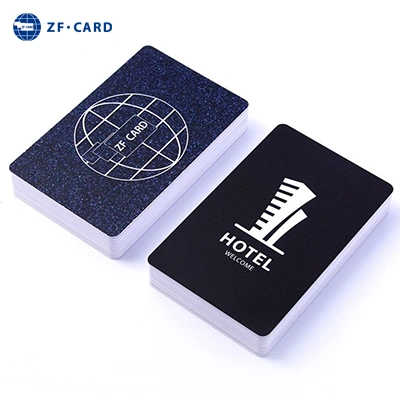
Custom Hotel Key Card Solutions
1. Confirm Lock-System Compatibility Before Artwork
The first question is not “What design do you want?” It is “What card does your hotel lock system require?”
Ask your supplier to confirm:
- Lock brand and model
- RFID, magnetic stripe, or dual-technology format
- Frequency and chip type
- Encoding or programming requirements
- Whether the cards will also be used for elevators, parking, energy-saving switches, or other access points
RFID key cards for hotels are not automatically interchangeable. Two cards may look identical but use different chips, frequencies, antennas, or encoding formats. A card that works with one access system may fail with another.
For the safest result, provide a working card sample, a photo of the lock system, or the exact lock brand and model. The supplier should verify compatibility before mass production—not after the cards arrive.
2. Confirm Hotel Key Card Dimensions and Thickness
The common hotel-card format is based on the ID-1 card size defined by ISO/IEC 7810: 85.60 × 53.98 mm with a nominal thickness of 0.76 mm.
This is a useful starting point, but standard size alone does not guarantee compatibility. Your purchase order should also specify:
- Card length, width, and thickness
- Corner radius
- Dimensional tolerance
- Surface flatness and warpage tolerance
- Antenna position
- Printing safe area and bleed
- Whether a special format, such as CR50, is required
If you are considering a custom shape, test it with the actual lock and reader first. Cutting too close to an RFID antenna or changing the card thickness may affect performance.

3. Choose the Material for the Hotel Environment
Material affects durability, appearance, price, and sometimes RFID performance.
Standard PVC is a practical choice for most hotels because it is durable, printable, and familiar to front-desk teams. PET or ABS may be considered for specific technical or environmental requirements. Wood-based cards can create a stronger brand impression, but the construction must protect the embedded RFID inlay.
The correct choice depends on where the card will be used:
- City hotels usually need reliable, cost-effective PVC cards.
- Resorts and waterparks may need better resistance to moisture, UV exposure, heat, and frequent handling.
- Boutique hotels may prioritize wood, textured finishes, foil, or premium printing.
- Hotel groups may prioritize consistent materials and repeat-order stability across properties.
If sustainability is part of your brand promise, ask for specific material documentation rather than relying on general terms such as “green” or “eco-friendly.” For wood-based products, an FSC Chain of Custody claim indicates that certified material has been tracked through the relevant supply chain. Always confirm whether the certification applies to the finished card, the material, or only part of the production process.
4. Define Printing and Branding Requirements
Branded hotel key cards are handled at check-in, carried by guests, and often photographed or retained. The card should support the guest experience without reducing readability or functionality.
Confirm the following design details:
- Front and back artwork
- Logo placement and brand colors
- CMYK, spot color, or Pantone requirements
- Matte, gloss, UV, foil, or special finishes
- Room information, Wi-Fi details, QR codes, or promotional content
- Variable data such as property names or card numbers
- Print-safe margins, bleed, and image resolution
For hotel groups, create one master design system with approved variations for each property, room type, campaign, or season. This makes future reorders easier and helps prevent inconsistent colors between locations.
Always approve both a digital proof and a physical sample. A PDF can show the layout, but it cannot fully show the final color, surface texture, edge quality, or card stiffness.
5. Clarify Bulk Quantity, MOQ, and Delivery Terms
A bulk quote should show more than a unit price.
For this project, ZFCARD’s standard MOQ is 500 cards. Confirm whether the MOQ applies to the total order or to each design, material, chip type, and encoding configuration.
Your quotation should clearly state:
- Total quantity and quantity per design
- MOQ and price breaks
- Sample and proofing costs
- Production lead time
- Shipping time and destination
- Packaging quantity and carton details
- Reorder pricing and design retention
- Replacement terms for defective or incompatible cards
ZFCARD’s standard lead time is 5–7 days after artwork, card specifications, and order details are confirmed. International transit time should be calculated separately based on the destination and shipping method.
If the cards are needed for a hotel opening or renovation, build design approval, compatibility testing, production, and transportation into the project schedule.
6. Set Quality-Control and Acceptance Standards
“Good quality” should be measurable.
Before approving production, agree on the acceptance criteria for:
- Door-lock reading performance
- RFID encoding or magnetic-stripe performance
- Card dimensions and thickness
- Print alignment and color consistency
- Scratches, stains, edge damage, and surface defects
- Bending, warpage, and lamination quality
- Quantity per package and carton
- Replacement process for rejected or incompatible cards
For multi-property projects, test representative cards with every relevant lock system. Do not assume that a sample tested at one location will work at every hotel.
Production must follow the approved artwork, physical sample, card technology, encoding specification, quantity, packaging standard, and agreed acceptance criteria.
This protects both the buyer and the manufacturer.
7. Choose the Right Card Technology
| Card type | Best suited for | Main advantage | Key confirmation |
|---|---|---|---|
| RFID card | Contactless hotel locks | Convenient and flexible | Chip, frequency, encoding, lock compatibility |
| Magnetic-stripe card | Legacy lock systems | Familiar and economical | Stripe type, encoding, durability |
| Dual-technology card | Hotels operating mixed systems | Supports system transition | Compatibility with both systems |
The right choice depends on your existing door hardware, not simply on which technology appears newer.
Common Ordering Mistakes
Avoid these frequent mistakes:
- Choosing a card from a photo without testing it.
- Assuming every hotel key card is RFID.
- Confirming CR80 size but not chip or encoding requirements.
- Approving artwork before functional testing.
- Treating “recyclable,” “biodegradable,” and “FSC-certified” as the same claim.
- Comparing only the unit price instead of total project cost.
- Failing to confirm whether different designs can share one bulk order.
Real-World Use Cases
Boutique Hotel
A boutique property may prioritize premium materials, foil, textured finishes, and a strong visual connection between the card and the hotel interior.
Resort or Waterpark
Resorts should focus on moisture resistance, UV stability, surface durability, and reliable RFID performance during frequent guest turnover.
Hotel Group or Lock-System Integrator
Multi-property projects need a master specification, approved design variations, consistent card materials, and repeat-order control across different locations.
Frequently Asked Questions
What are the standard hotel key card dimensions?
The common ID-1 format is 85.60 × 53.98 mm and approximately 0.76 mm thick. Always confirm the exact tolerance and lock requirements before ordering.
Are hotel key cards RFID or magnetic stripe?
Both types are used. The required format depends on the hotel’s door-lock system. RFID, magnetic stripe, and dual-technology cards are not automatically interchangeable.
How can I make sure custom cards work with my hotel locks?
Send the supplier your current card, lock brand and model, card technology, and encoding requirements. Approve a functional sample before mass production.
What should I include in a bulk quotation request?
Include the lock system, chip, frequency, card size, thickness, material, artwork, finish, encoding, quantity, MOQ, delivery destination, target date, packaging, and quality requirements.
Request a Custom Hotel Key Card Quote
To receive an accurate quotation, send your current card or lock information together with your artwork, required quantity, preferred material, and delivery destination.
ZFCARD provides custom hotel key cards, RFID card manufacturing, OEM/ODM support, custom printing, rapid prototyping, and bulk production for hotels, lock-system companies, and international distributors. View the hotel key card solution or contact ZFCARD for a project quote.