


With the increasing prevalence of intelligent identity recognition and contactless management systems, smart RFID cards have been widely applied in access control, hotel systems, membership identification, and payment scenarios. In practical applications, the operational stability of an RFID system does not entirely depend on chip performance but is more significantly influenced by the overall card structure and material selection.
From a long-term usage perspective, the card's physical strength, environmental adaptability, and packaging stability often determine the true lifespan of an RFID card. Therefore, PVC cards have gradually become one of the most mainstream and mature carrier materials in the smart card industry. This article will systematically analyze how PVC cards can effectively improve the lifespan of smart RFID cards, focusing on the structural advantages, manufacturing processes, and customized designs of PVC material.
What Limits the Service Life of Smart RFID Cards
The service life of intelligent RFID cards is not solely determined by the chip, but is influenced by multiple factors in combination.
• Structural damage from physical stress: In applications such as access control, hotels, and employee management, RFID cards typically experience physical stress from high-frequency swiping, repeated bending, and daily friction. If the card material lacks sufficient toughness, cracks, delamination, or deformation can easily occur, ultimately affecting the normal operation of the chip and antenna.
• Environmental factors: Temperature changes, humidity, and ultraviolet radiation all accelerate material aging. Low-quality materials are prone to deformation at high temperatures and become brittle in cold environments. Furthermore, if the PVC card supplier does not use a UV-resistant coating, prolonged exposure to sunlight can cause the card surface to yellow, the pattern to fade, and even affect the structural integrity of the internal materials.
• Chemical and grease contamination: In industrial or catering environments, access control cards are frequently exposed to cleaning agents, solvents, or grease from human sweat. These chemicals can penetrate into the lamination gaps of inferior cards, causing delamination, which in turn allows moisture to seep in and oxidize the internal RFID chip and antenna.
• Magnetic field interference: Although RFID is contactless, strong external magnetic fields can still damage the internal chips.
Why PVC Material is Ideal for Smart RFID Cards
Due to its outstanding physical properties, excellent processing technology adaptability and cost advantages, PVC has become the most widely used material in the smart card industry. For smart RFID cards that require frequent use, PVC is not merely a plastic casing; it is also a precisely designed protection system.
1. Excellent mechanical properties and structural stability
PVC possesses outstanding flexibility and resistance to bending. This is crucial for smart RFID cards used over a long period. Compared to ordinary plastics or paper cards, PVC cards can maintain structural integrity better under repeated bending, compression, and friction, effectively protecting the internal chips and antennas.
• Bending resistance: The PVC material can withstand multiple high-frequency swipes and daily bending without cracking, reducing damage to the chips caused by external forces.
• Durability: The surface hardness is moderate, preventing scratches during swiping, storage, or insertion into a wallet.
• Size stability: PVC has a low shrinkage rate under temperature and humidity changes, ensuring that the cards do not deform over a long period of use, allowing access control cards to be recognized normally in any environment.
2. Excellent laminating and packaging compatibility
The intelligent RFID card needs to encapsulate the chip and antenna within the card body. The PVC material can well adapt to the lamination process, ensuring the long-term stability of the multi-layer structure.
• High-temperature resistant lamination: PVC has a high tolerance for lamination temperature and is unlikely to cause bubble formation or delamination during the packaging process.
• Stable chip fixation: The PVC material has an appropriate density, which can firmly fix the RFID chip and antenna, reducing the failure of reading and writing due to physical movement.
• Multi-process compatibility: Whether it is thermal transfer, offset printing, UV ink, or laser coding, PVC can ensure clear printing without affecting the chip function.
3. Superior Environmental Adaptability
PVC material maintains stable performance under various environmental conditions, which is crucial for the long-term use of smart cards.
• Moisture Resistance: PVC does not easily absorb moisture, and even in high-humidity environments, it is not prone to expansion or deformation.
• Temperature Resistance: PVC cards can operate normally under high or low temperature conditions in common office, hotel, and enterprise access control environments without affecting chip functionality.
• UV resistant: PVC cards with a surface coating reduce fading or surface aging caused by sun exposure.
How PVC Material Protect RFID Chips and Antennas
In smart card applications, the RFID chip and antenna serve as the core functional components. Even with high-performance chips, unstable card materials can lead to damage from external forces, environmental factors, or prolonged use, causing smart RFID cards to fail. PVC material, with its unique physical properties and adaptability to multi-layer structures, emerges as the ideal material for protecting chips and antennas.
1. Structured Encapsulation Protection
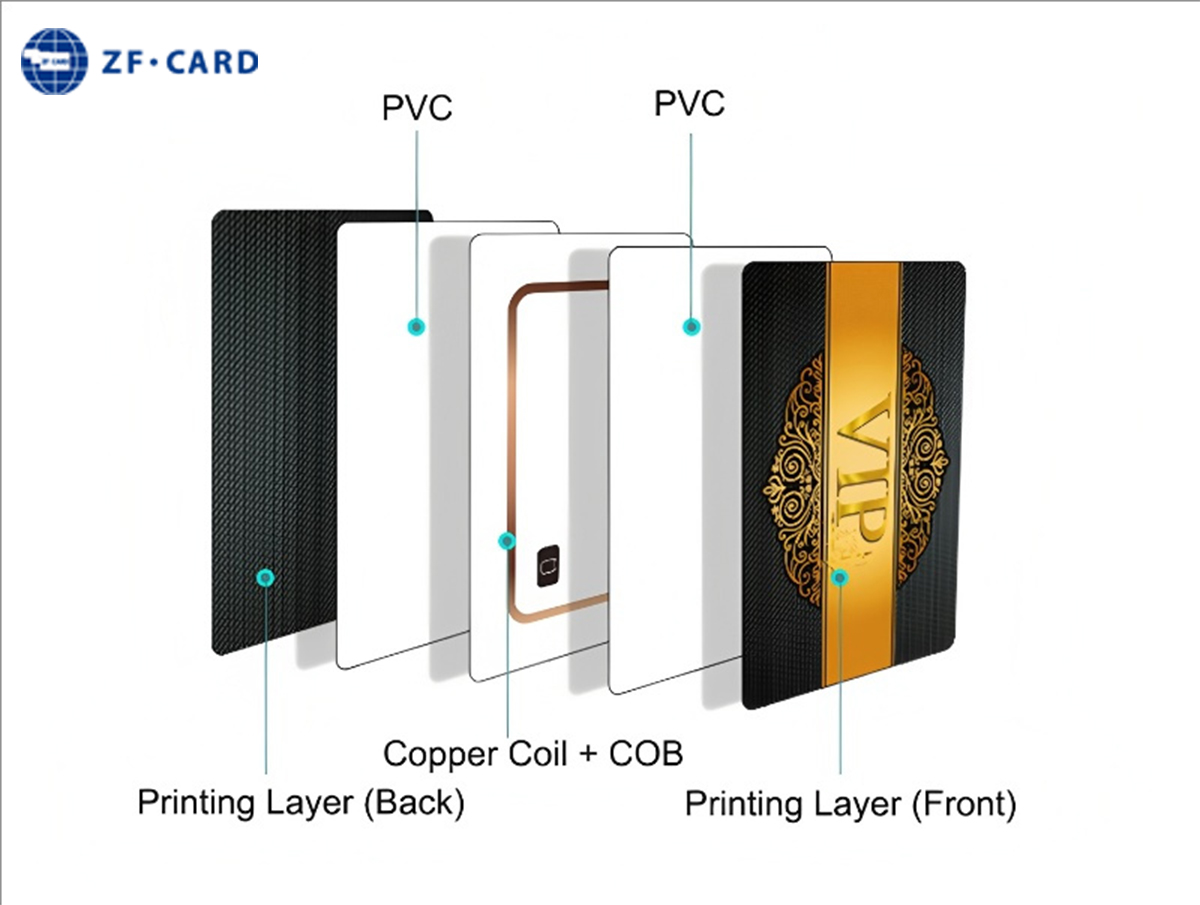
A PVC card typically consists of multiple layers of material.
• Core Support Layer: The chip and copper coil are precisely embedded within the Core PVC. This layer provides essential physical support, preventing internal components from shifting under compression.
• Bidirectional Cushioning Barrier: Both sides of the core PVC are usually covered with a layer of high-purity PVC lining material. During the lamination process, these materials liquefy under high temperature and pressure, filling the minute gaps around the chip. For custom PVC cards, this all-around encapsulation effectively absorbs external impact forces, preventing the chip from shattering due to violent collisions.
2. Superior Airtightness and Waterproofing
PVC card materials exhibit exceptional hydrophobicity and molecular fusion properties. Through precise thermal lamination, successive PVC layers bond into an impervious, light-blocking monolith. This process creates a near-vacuum sealed environment for smart RFID cards.
• Corrosion Resistance: This seal blocks oxygen and moisture, preventing oxidation of the copper coil antenna and ensuring long-term signal transmission stability.
• Water Resistance: For access control cards, internal precision circuits remain fully protected even if accidentally submerged or used in rainy conditions.
3. Anti-Static & Electromagnetic Shielding Support
In dry conditions, static electricity generated by the human body can reach thousands of volts, potentially damaging RFID chips. Professional PVC card suppliers incorporate appropriate amounts of antistatic agents into the material formulation of custom PVC cards or leverage PVC’s inherent insulating properties to provide a natural conductive shielding layer for internal chips. This ensures that upon contact with a reader, current is evenly dispersed, protecting sensitive integrated circuits from high-voltage damage.
4. Additional Physical Protection
A transparent PVC overlay film is typically applied to the outermost layer of PVC cards. Though lightweight, this film serves critical functions:
• Abrasion Resistance: It shields the underlying printing layer while acting as the chip’s final defense.
• UV Protection: High-quality overlays filter out most harmful ultraviolet rays, preventing structural failure of smart RFID cards due to material degradation.
Through this multi-layered design from the inside out, smart card manufacturers ensure every PVC card leaving the factory provides reliable protection for the internal RFID chip in harsh daily usage environments.
Extending Service Life Through Custom PVC Card Design
Customized design not only concerns the appearance, but also serves as an important means to enhance system stability and reduce long-term operating costs.
1. Surface Coating
Damage to the card surface often signals impending failure of PVC cards. Selecting different surface treatment processes can alter the card's abrasion resistance.
• Frosted and Matte Finishes: These are the preferred options for high-frequency access control cards. This process disperses micro-scratches at the microscopic level, ensuring the card maintains a clean appearance even after thousands of swipes through readers.
• UV-Resistant Coating: A specialized UV-resistant overlay prevents PVC material from yellowing and becoming brittle, thereby preserving the stability of the internal sealing structure.
2. Tear-Resistant Design
For access cards that need to be temporarily deactivated, such as employee badges or lanyard cards, the failure of perforation is often the main cause of the card becoming invalid.
• Reinforced Punching: Custom PVC card designs can incorporate additional reinforcement layers at pre-set perforation points or utilize tear-resistant composite materials, ensuring the card won’t detach from hooks due to prolonged pulling.
• Optimized Rounded Corners: Standard corner designs not only enhance ergonomics but also effectively reduce stress concentration during edge impacts, preventing delamination of the PVC card.
3. Printing Process
To prevent fading of brand logos and serial numbers, PVC card suppliers typically employ sandwich printing. Patterns are printed onto white PVC material, then covered with a transparent overlay. This design physically isolates the graphics from external elements. Even if the surface of smart RFID cards is slightly scratched, core visual information and anti-counterfeiting UV ink remain clearly visible.
High Frequency Application Scenarios of PVC Cards
With its stable material properties and mature manufacturing process, PVC cards have become the mainstream choice for smart RFID cards in high-frequency applications.
• Access Control and Identification Systems: In businesses and public facilities, access control cards need to be used repeatedly every day. PVC material can effectively withstand the physical pressure from high-frequency card swiping, maintaining stable performance.
• Hotel Room Key Systems: Hotel applications have extremely high requirements for card stability and consistency. PVC cards can maintain good recognition performance over a long period in contactless reading and writing environments.
• Multifunctional Smart Card Applications: Smart RFID cards that integrate identification, payment, encryption, and information storage functions rely more heavily on the long-term stability of the card body material. PVC has a clear advantage in this type of application.

Choosing the Right PVC Card Supplier for Long-Term Reliability
The actual lifespan of smart RFID cards is determined not only by the materials themselves but also by the stable manufacturing capabilities and mature process control of the PVC card supplier.
Consistency in manufacturing processes is a core indicator of supplier reliability. Experienced smart card manufacturers rigorously control pressure and temperature parameters during card lamination, chip packaging, and antenna embedding to ensure a high degree of structural consistency in each custom PVC card. Only a stable process can prevent performance degradation due to minor internal structural variations, thus guaranteeing the long-term reliability of smart RFID cards.
From a long-term usage perspective, a robust quality control system is equally crucial. Professional PVC card suppliers typically conduct bending tests, abrasion tests, and read/write stability tests before shipment to simulate real-world high-frequency application environments. This usage-driven quality control significantly reduces the risk of performance issues after delivery.
Furthermore, customization capabilities are also an important consideration when selecting a supplier. As application scenarios become increasingly segmented, user demands for custom PVC cards are no longer limited to appearance design but encompass multiple aspects such as chip compatibility, surface treatment, magnetic stripe configuration, and functional expansion.
By partnering with suppliers possessing mature manufacturing capabilities, rigorous quality control, and comprehensive customization services, companies can not only extend the lifespan of smart RFID cards but also better control costs.
Conclusion
By selecting appropriate materials, designing the structure and implementing customized processes, PVC materials can significantly extend the service life of smart RFID cards and reduce long-term operating costs.
As a professional smart card manufacturer, ZFCard is committed to providing high-quality custom PVC cards and smart card solutions to global customers. From materials, processes to application scenarios, it ensures the long-term stable operation of the cards in all aspects.
FAQ
Q1: Why is PVC material more suitable for making Smart RFID Cards compared to other plastics?
A1: PVC has excellent flexibility, impact resistance, and dimensional stability. It can effectively protect the chips and antenna structures inside the smart RFID cards during long-term bending and frequent card swiping, while maintaining stable reading and writing performance. This is something that many alternative materials cannot achieve over the long term.
Q2: Can we make a sample first to confirm the quality before placing a large order?
A2: Yes. We offer a free sample service for custom PVC cards. Customers can confirm the card material, printing effect, chip performance, and reading/writing stability during the sample stage to ensure that the final product meets the actual usage requirements, and then proceed to mass production.
Q3: What is the minimum order quantity (MOQ)?
A3: The minimum order quantity for our PVC cards is 500 pieces. This quantity setting ensures stable product quality and is suitable for small and medium-sized projects for testing and long-term cooperative customers to gradually increase production.
Q4: Can we recommend an appropriate chip solution based on the project requirements?
A4: Yes. As an experienced smart card manufacturer, we will recommend appropriate chip solutions based on the application scenarios (such as access control, hotels), helping customers strike a balance between cost, performance and lifespan.