

Introduction
Choosing a passive RFID card is not simply a matter of buying a battery-free credential at the lowest cost. The card must match how users present it, where readers are installed, what the existing system supports, and how identity data is authenticated. With more than two decades of smart card manufacturing experience, ZF CARD approaches this decision by matching the chip, frequency, protocol, card construction, and personalization method to the complete application. This guide explains when passive RFID cards are suitable for access control and ID systems, when another power architecture may be necessary, and what buyers should confirm before approving an order.
Quick Answer: When Is a Passive RFID Card the Right Choice?
A passive RFID card is usually the right choice when users intentionally present the card to a fixed reader, the credential only needs to operate within the reader field, and the project requires many cards without battery management. It works well for employee access, attendance, hotel locks, campus IDs, and membership systems when the reader frequency, protocol, chip family, credential format, and security method are already known. It is less suitable when the credential must continuously broadcast its location, collect data away from a reader, or provide consistently long-range identification. Passive RFID is a power architecture, not a complete card specification.
What “Passive” Means in an RFID Card System
How the Card Gets Power and Returns Data
A passive RFID card has no internal battery. When it enters the electromagnetic field of a compatible reader, the embedded antenna captures enough energy to activate the chip. The chip returns identification or application data, and the reader passes that information to the access control, attendance, hotel lock, or membership platform.
The exchange only occurs within a usable reader field. The card does not independently broadcast outside that field. A detailed explanation is available in how RFID cards work.
What Passive Does Not Tell You
“Passive” does not define the card’s frequency, protocol, memory, reading distance, security capability, or reader compatibility. A basic 125 kHz identification card and a 13.56 MHz card supporting authenticated data exchange may both be passive, but they are not interchangeable.
This distinction matters because buyers often treat “passive RFID card” as a complete specification. It is only the starting point. The system still needs a defined chip, data format, reader interface, and security method.
Match the Card to the Required Read Behavior
Do not select a card from a maximum read-distance claim alone. First decide whether users will tap the card, wave it within a controlled zone, or pass through without stopping.
LF for Close-Range Legacy Identification
Low-frequency cards, commonly used around 125 kHz, remain practical in established proximity and attendance systems. They are often suitable when the installed reader network already supports a specific LF chip or credential format and replacing the infrastructure is not part of the project.
ZF CARD’s LF options, including HITAG, T5577, and EM-series configurations, show why buyers should identify the exact chip rather than request a generic “125 kHz card.” Frequency matching alone does not confirm compatibility.
LF also does not represent one security level. Some systems mainly read a fixed identifier, while others use different chip functions or backend controls. Security must be judged across the credential, reader, controller, and database.
HF for Access, Identity, and Multi-Application Cards
High-frequency passive cards commonly operate at 13.56 MHz and are used for office access, hotel locks, campus IDs, membership programs, and other contactless identity systems.
Depending on the selected chip, an HF card may support configurable memory, read-write functions, application sectors, authentication, or encrypted communication. MIFARE Classic, DESFire, Ultralight, Plus, and ICODE are different chip families with different capabilities; they should not be treated as equivalent “HF cards.”
Before ordering, confirm the reader standard, chip family, data layout, key ownership, encoding responsibility, and backend requirements. A reader operating at 13.56 MHz will not necessarily support every 13.56 MHz card.
UHF for Longer-Range or Hands-Free Identification
UHF passive cards may suit parking, vehicle access, or selected personnel-identification projects that require a larger recognition zone or less deliberate card presentation.
Performance depends on the full installation: card and reader antennas, orientation, polarization, mounting position, nearby materials, user position, and regional reader settings. The aim should be a controlled reading zone that detects authorized cards where required without creating unwanted reads beyond the entry point.
Why Read Range Must Be Tested as a System
Provide the supplier with the reader model, antenna location, expected presentation distance, card orientation, user movement, surrounding materials, and minimum acceptable read success rate. Samples should then be tested in the real installation.
A card that works when held still may respond differently in a wallet, on a lanyard, or while moving through a gate. Practical read behavior is a system result, not a fixed property of the card alone.
Where Passive RFID Cards Are a Good Fit
Employee Access and Attendance
Passive cards suit fixed doors and attendance terminals because users intentionally present the credential, while centralized software manages permissions, event records, and lost-card cancellation. Higher-risk sites may still require authenticated chips, better key management, or an additional verification factor.
Campus, Hotel, and Membership Programs
Passive HF cards can support room or area access, identity verification, membership recognition, and selected stored data. The application determines the configuration.
A hotel project should confirm the lock reader, encoder, card chip, sector configuration, and management workflow. A campus card may need separate applications for access, attendance, dining, or library use. A membership card may only need a reliable identifier linked to a backend account.
These projects may use RFID cards or contactless IC cards, but the category still needs to be narrowed to a specific technical configuration.
High-Volume Credential Deployment
Passive cards are practical when an organization must issue and replace large quantities of credentials. There is no battery replacement schedule, and the chip, printing, numbering, and encoding specifications can be standardized for repeat orders.
However, “no battery” does not mean “no lifecycle cost.” Buyers should still consider loss, reissuance, printing wear, encoding, secure storage, reader upgrades, and batch testing.
When Passive RFID Cards Are Not the Best Choice
A standard passive card is usually unsuitable when the credential must continuously broadcast its location, support real-time tracking across a wide area, or communicate reliably when no reader field is present.
Another architecture may be necessary when a device must independently record sensor data, send scheduled updates, issue alerts, preserve time-stamped information away from a reader, or maintain continuous long-range communication.
Passive cards should also not be ordered when compatibility is unconfirmed. Matching “125 kHz” or “13.56 MHz” is insufficient if the chip family, protocol, data organization, keys, facility code, or card-number format differs.
Passive RFID Card Specification Checklist
Existing Reader and System
Provide:
- Reader and encoder brand and model
- Operating frequency and supported protocol
- Current card or chip model
- Facility code, credential format, or data structure
- Backend access-control or identification platform
- Whether readers, controllers, or software may be changed
For replacement projects, a working reference card may assist technical comparison, subject to authorization and data-security rules.
Chip and Security Requirements
Confirm:
- Required chip family
- UID-only identification or authenticated communication
- Memory and read-write requirements
- Encryption and key-management responsibilities
- Sector or application configuration
- Who will encode and personalize the cards
- Procedures for issuing, revoking, and replacing credentials
Security must be designed across the card, reader, controller, software, and operating process. An advanced chip cannot compensate for exposed keys or uncontrolled issuance.
Card Construction and Personalization
After electronic compatibility is confirmed, define the physical card. A common format is 85.5 × 54 × 0.76 mm, but material, thickness, finish, and printing should suit the environment.
ZF CARD can configure projects using PVC, PET, PLA, PC, or ABS, with matte, glossy, or frosted surfaces and options such as offset printing, screen printing, laser codes, serial numbers, embossing, and custom graphics. These are selectable features, not default requirements.
Also specify photos, barcodes, QR codes, signature panels, holes, slots, magnetic stripes, or other secondary features. Added elements should be checked against antenna placement and card construction.
Sample and Acceptance Testing
Do not approve a card from appearance alone. Test samples on the actual readers and encoders and verify:
- Detection position, speed, angle, and orientation
- Read, write, UID, card number, or encoded data
- Authentication and key configuration
- Intended read-zone boundaries and unwanted reads
- Dimensions, printing, surface finish, and numbering
- Consistency between samples and production batches
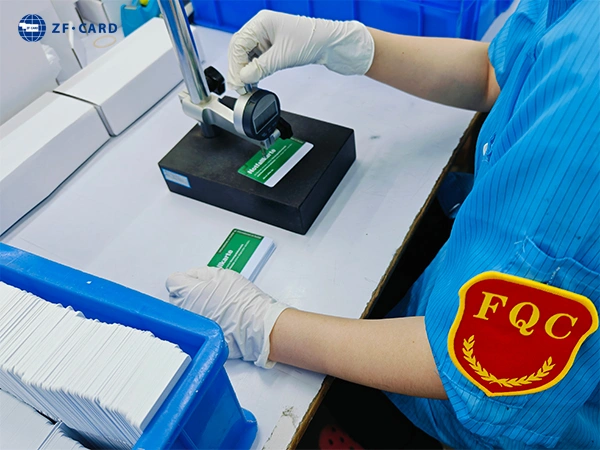
ZF CARD’s production workflow includes chip function checks, inlay frequency testing, read-write verification, and finished-card inspection. These controls are most useful when the purchase specification defines measurable acceptance criteria that can also be checked upon delivery.
Conclusion
Passive RFID cards are usually a practical choice when credentials operate at fixed reader points, users intentionally present them, and the project requires high-volume issuance without battery management. The decision is reliable only after the frequency, protocol, chip family, credential format, security method, and physical card specifications are confirmed. Projects requiring autonomous transmission, continuous location tracking, offline sensing, or consistently long-range communication may need another power architecture. Before bulk ordering, test the proposed card in the real system and approve both electronic performance and physical construction.
FAQ
Can One Passive RFID Card Work with Both LF and HF Readers?
Only if it is specifically designed as a dual-frequency card with separate compatible chip and antenna structures. A standard single-frequency card cannot gain another frequency through encoding.
Is Matching the Frequency Enough When Replacing a Card?
No. The replacement may also need to match the protocol, chip family, identifier, memory structure, keys, facility code, and credential format.
Should Cards Be Encoded Before or After Printing?
Either may be possible. The order should define who owns the keys, what data is written, how encoding records match printed numbers, and how failed cards are handled.
How Should Unissued Cards Be Controlled?
Blank or pre-encoded stock should be recorded, securely stored, and issued through an authorized process. Access to encoders, keys, and credential data should be restricted.
Can Passive RFID Cards Coexist with Mobile Credentials?
Yes, when the readers, controllers, and backend platform support both formats. A mixed deployment should define enrollment, revocation, fallback access, and security policies for each credential type.